)
)
)
)
Taking the Next Steps to Deliver ESN
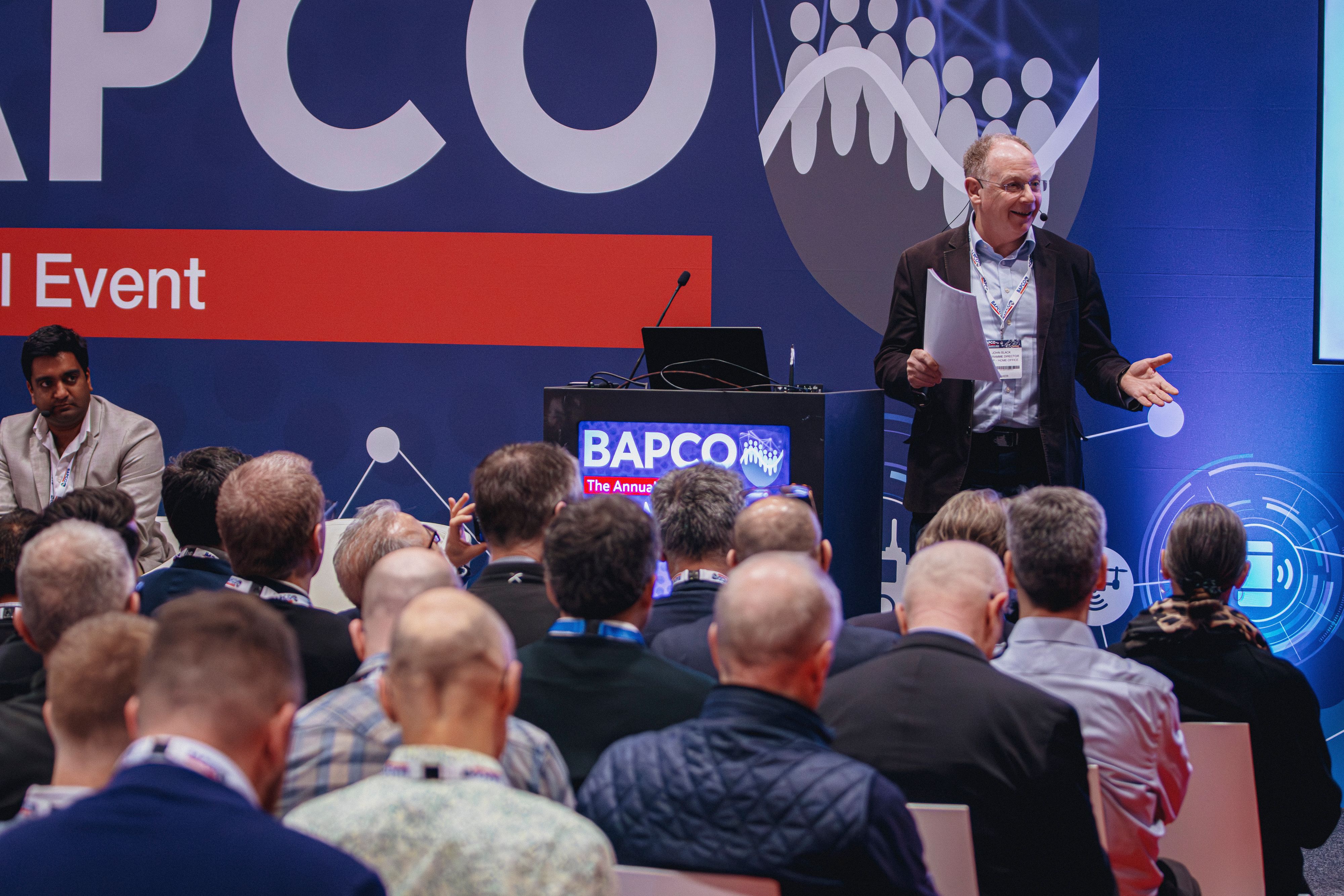
One of the biggest sessions at BAPCO 2026 saw leaders from ESMCP, BT/EE and IBM provide a detailed update on the delivery, testing and transition roadmap for the UK's Emergency Services Network.
Speakers
- John Black, Programme Director - ESMCP, Home Office
- Faisal Mahomed, Managing Director - ESN, BT/EE
- Steve Kelly, ESN Implementation and Integration Leader, IBM
Watch the full session
Hear the full update from ESMCP, BT/EE and IBM as they outline ESN progress, major infrastructure milestones, testing at scale and the roadmap towards national transition.
▶ Watch on YouTubeBAPCO 2026: ESN Programme Sets Out Roadmap to National Transition
One of the most anticipated sessions at BAPCO 2026 saw leaders from the Emergency Services Mobile Communications Programme, BT/EE and IBM provide one of the most detailed public updates yet on the delivery of the Emergency Services Network.
Taking place in Theatre A – People: Keynote & Strategy, Taking the Next Steps to Deliver ESN brought together John Black, Programme Director for ESMCP, Faisal Mahomed, Managing Director for ESN at BT/EE, and Steve Kelly, ESN Implementation and Integration Leader at IBM.
The session marked a clear shift in tone. While previous updates have focused heavily on procurement, commercial milestones and planning, this year's presentation focused on delivery, testing, operational readiness and transition.
"It's time for us all to get to work."
John Black, Programme Director, ESMCPESN moves from planning to delivery
Opening the session, John Black explained that the programme has spent recent years navigating complex commercial discussions, reprocurement activity and contract delivery. Following the award of the new User Services contract and the renewal of the Mobile Services contract, the programme is now able to report clear progress.
Black outlined the core structure of ESN, with Mobile Services delivered by BT/EE and User Services delivered by IBM and its partners. Mobile Services covers the radio access network, coverage, resilience and lower core network. User Services covers the mission critical communications platform, business support systems, data centres, service management model and upper core network.
Around these core services sits a wider ecosystem of devices, control room connectivity, air-to-ground services, interworking with Airwave and other supporting contracts.
Major infrastructure milestones achieved
Steve Kelly used the session to explain the scale of the infrastructure now in place. Two of ESN's three national data centres have now been built, with the third progressing. Each data centre will be capable of running the full ESN load, providing the level of resilience required for mission critical communications.
The programme has already deployed more than 2,000 servers and delivered significant infrastructure across the data centre estate. Kelly also confirmed that Mobile Services and User Services have now been connected across the core networks, a critical step towards end-to-end integration and testing.
He also highlighted progress on the business support system, service management capability and SIM design, all of which are essential to provisioning users, securing calls and supporting the service once it becomes operational.
Testing ESN at scale
A major theme of the session was the level of real-world testing already completed. John Black explained that ESN has been tested at scale across major public events including football stadiums, Notting Hill Carnival and New Year's Eve celebrations in London.
The programme has been seeking to answer a central question from the emergency services community: can ESN deliver critical communications when commercial networks are congested?
Black said the programme has now proven that priority and pre-emption work at scale, giving emergency services users the critical communications access they need even in high-demand environments.
"We've proved it. We now know we can make this work at scale."
John Black, Programme Director, ESMCPBT/EE outlines Mobile Services progress
Faisal Mahomed explained that BT/EE's guiding principle has been simple: emergency services users need to know they can be heard and can hear others when it matters most.
He reported that the baseline deployment for coverage has been completed and that the next phase is focused on resilience and enhancement. More than 250 resilience sites are already in place, while more than 1,000 indoor coverage locations have been surveyed.
Mahomed also highlighted that ESN-related network improvements have already enabled around 20,000 additional 999 calls over the last year, demonstrating that investment in the programme is already delivering public safety benefit.
From network readiness to service readiness
Looking ahead, BT/EE is moving from network readiness towards service readiness. This includes preparing for major incidents, testing operational response models and running scenario-based exercises.
Mahomed explained that this work will include war games and close engagement with users to test how the network and service model will operate during demanding real-world incidents.
Operational tools shown to the BAPCO audience
The session also included demonstrations and scenario-based examples showing how ESN capabilities could support emergency services activity in practice.
The ESN Coverage Intelligence Portal was shown as a planning tool for authorised users, allowing emergency services teams to understand expected coverage before deployments, planned events and operational activity.
The programme also highlighted Rapid Response Vehicles, which are designed to provide temporary coverage and capacity during major events, power outages and emergency incidents. The latest vehicles use low-earth orbit satellite links to improve reliability and reduce deployment times.
Samsung also demonstrated the ESN Mission Critical Services client, showing push-to-talk, emergency alerts, group communications, one-to-one calls, messaging, image sharing and location services.
Notting Hill Carnival provides a major proof point
Notting Hill Carnival was used as a key example of ESN testing under intense pressure. With around two million visitors and thousands of emergency services personnel in attendance, the event places major demand on communications networks.
Testing at the carnival demonstrated the use of priority access, dedicated carrier capability and network tuning. Speakers explained that while normal commercial devices experienced degraded service in the crowded environment, ESN devices maintained strong performance.
These events have provided the programme with valuable evidence that ESN can support emergency services users in complex, high-demand environments.
The first public transition timeline
The most significant announcement came towards the end of the session, when John Black set out the programme's transition roadmap.
Black confirmed that the programme remains on track for Full Voice Service Ready by March 2028, with Q2 2028 used as the planning marker. This milestone means the core voice service, central network, mission critical systems, business support systems and service management model will be ready to support transition.
The programme then plans to begin mass transition in Q4 2028, following operational pilots and governance activity with user organisations.
Transition complete is targeted within 18 to 21 months from the start of mass transition. This would involve moving approximately 350,000 users, 45,000 vehicles and more than 100 organisations onto ESN.
What happens next?
The clear message from BAPCO 2026 was that ESN is entering a critical phase. The focus now moves from infrastructure build towards integration, testing, operational readiness and transition planning.
For emergency services organisations, technology suppliers, control room providers and the wider public safety communications community, the next stage will require active preparation.
ESN is no longer just a future concept. The programme is now moving towards service readiness, operational pilots and national migration.
The conversation continues in Liverpool
BAPCO returns on 23-24 March 2027 as the public safety communications community comes together for the next chapter of the Emergency Services Network journey.
Register Interest for BAPCO 2027